
Local flexibility markets many platforms, converging products
Seven platform models across eleven countries – yet the products traded on local flexibility markets are converging on just two families and two procurement typ
October 15, 2026
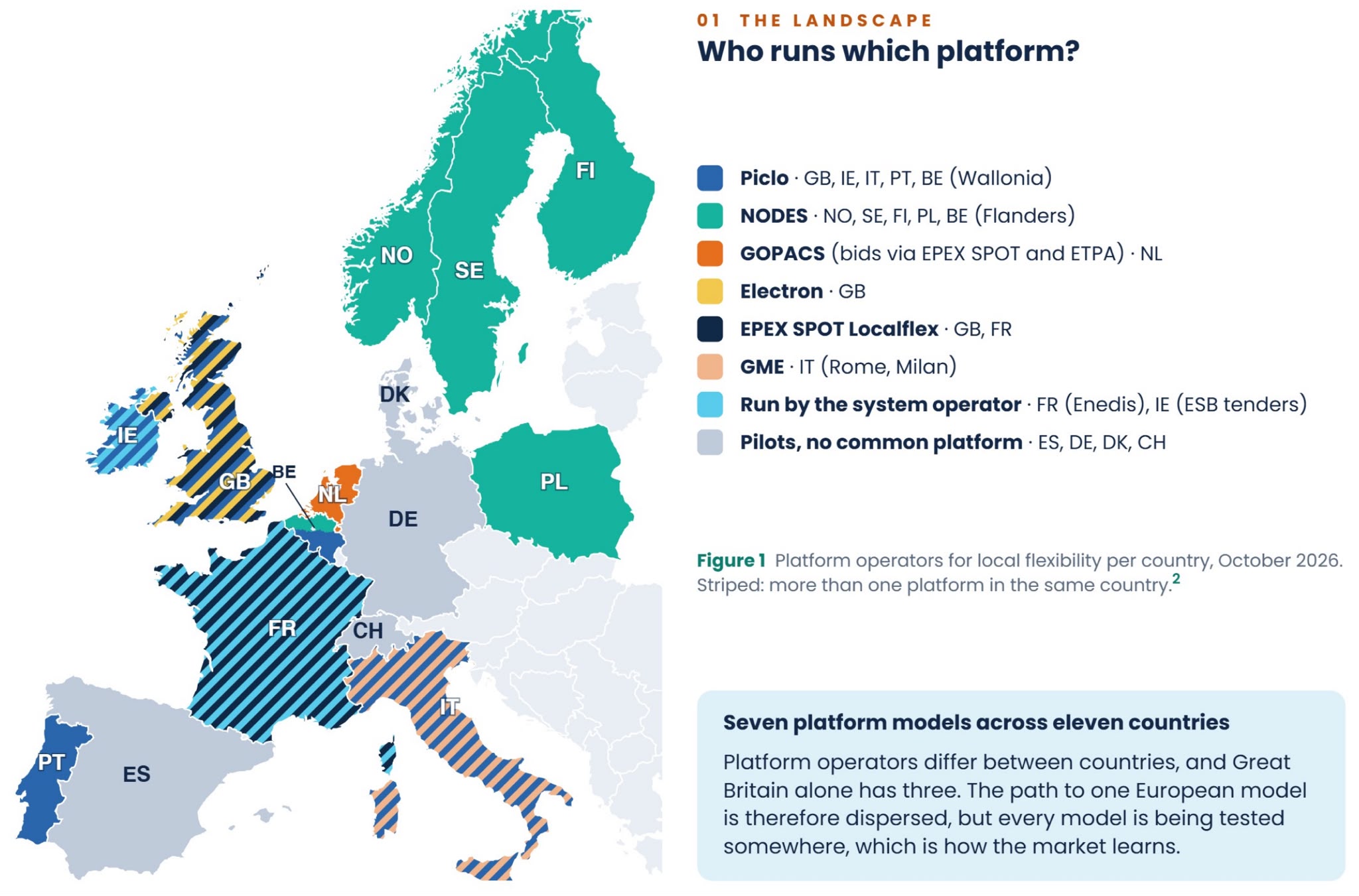
Local flexibility markets in Europe are still largely in a pilot and test phase, and it is not yet proven that they attract enough liquidity to resolve congestion structurally. Still, on the distribution grid they are today the only way to tap flexibility that already sits behind existing connections, or that can be added without requesting a new grid study.
Who runs which platform?
Platform operators differ from country to country, and Great Britain alone has three. Across eleven countries, we count seven platform models:
- Piclo – GB, IE, IT, PT, BE (Wallonia)
- NODES – NO, SE, FI, PL, BE (Flanders)
- GOPACS (bids via EPEX SPOT and ETPA) – NL
- Electron – GB
- EPEX SPOT Localflex – GB, FR
- GME – IT (Rome, Milan)
- Run by the system operator – FR (Enedis), IE (ESB tenders)
Spain, Germany, Denmark and Switzerland run pilots without a common platform. The path to one European model is therefore dispersed – but every model is being tested somewhere, and that is how the market learns.
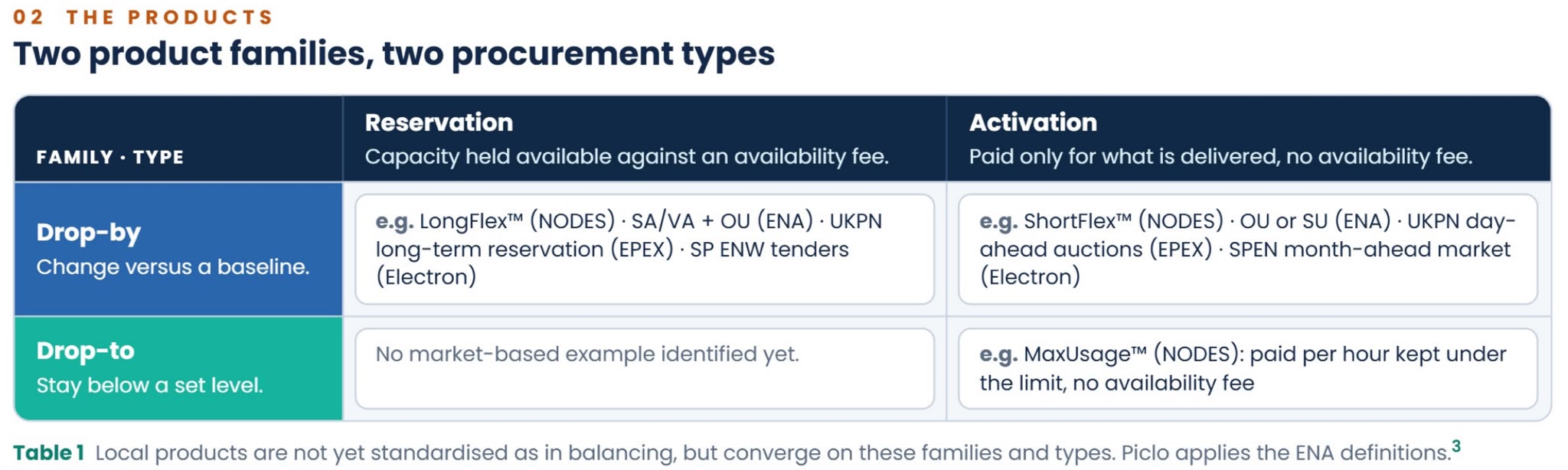
Two product families, two procurement types?
Local products are not yet standardized the way balancing products are, but they converge on two families:
- Drop-by – a change versus a baseline.
- Drop-to – staying below a set level.
Each can be procured in two ways:
- Reservation – capacity held available against an availability fee. Examples: LongFlex™ (NODES), SA/VA + OU (ENA), UKPN long-term reservation (EPEX), SP ENW tenders (Electron).
- Activation – paid only for what is delivered, with no availability fee. Examples: ShortFlex™ (NODES), OU or SU (ENA), UKPN day-ahead auctions (EPEX), SPEN month-ahead market (Electron), and MaxUsage™ (NODES), which pays per hour kept under the limit.
One combination is still empty: we have not yet identified a market-based drop-to reservation product.
That's where we come in
We help system operators design local flexibility products and set up the market around them.
Sources: LCP Delta / smartEn, Market Monitor for Demand Side Flexibility (2025); DSO Entity, Markets for Local Services (Feb 2026); Piclo (Oct 2026); NODES; EPEX SPOT (Apr 2026); SP Energy Networks (Apr 2026); TGE (Jan 2026); CRE délibération 2026-161; Fluvius, productfiches v4.2 (Oct 2025); ENA standard DNO products (FMR v3.2); EPEX SPOT Localflex (UKPN); SPEN and SP ENW on Electron (2024, 2026).